PestLock Pest ControlPestLock Pest Control

Subterranean Termite Soil Defense Los Angeles

Subterranean termite defense in Los Angeles County targets Reticulitermes hesperus, a native species that nests deep in soil moisture and builds mud exploratory tubes over stem walls to consume Douglas fir framing.…
Get My Free Estimate →(424) 573-8524
Subterranean Termite Soil Defense in Los Angeles, CA
Quick answer
  • Application involves digging a 6-inch by 6-inch soil trench along the perimeter footing and pressure-injecting non-repellent termiticide at four gallons per ten linear feet.
  • Service calls dispatch within twenty-four to forty-eight hours, with on-site perimeter treatments completing in four to eight hours.
  • Treatment costs run from $1,200 to $3,500 depending on home perimeter footage and slab drilling requirements, with an absolute service minimum of $250.
  • Technicians neutralize active subterranean colonies (Reticulitermes hesperus) and seal subterranean entry routes through expansion joints and plumbing voids.
  • Scheduling requires an on-site perimeter measurement; dispatch arrangements take place directly by calling (424) 573-8524.

Subterranean termite defense in Los Angeles County targets Reticulitermes hesperus, a native species that nests deep in soil moisture and builds mud exploratory tubes over stem walls to consume Douglas fir framing. Properties in the foothills of Silver Lake, Los Feliz, and Echo Park frequently feature sloping lots where hillside soil makes direct contact with raised-foundation mudsills, granting undetected subterranean access behind stucco. In flat-slab residential tracts across Sherman Oaks, Woodland Hills, and Mid-City, subterranean foragers exploit unsealed slab expansion joints, garage step-downs, and bath-trap dirt boxes under concrete. Venice beach bungalows and Brentwood estates encounter distinct soil compositions, ranging from porous marine sand to heavy adobe clay, that dictate specific termiticide dilution and pressure adjustments to ensure an unbroken chemical bond.

Establishing an external chemical barrier addresses subterranean species by utilizing non-repellent active agents, such as fipronil, which worker termites cannot detect, leading to lethal transfer across the central nest through social grooming. This differs from fumigation tenting: whole-structure sulfuryl fluoride gas fumigation is designed specifically for drywood termites nesting entirely inside structural lumber and leaves zero residual soil protection, meaning drywood gas offers zero defense against ground-dwelling subterranean colonies. Conversely, subterranean soil treatment does not eradicate aerial drywood infestations situated in attic rafters, requiring distinct structural diagnostics prior to dispatch.

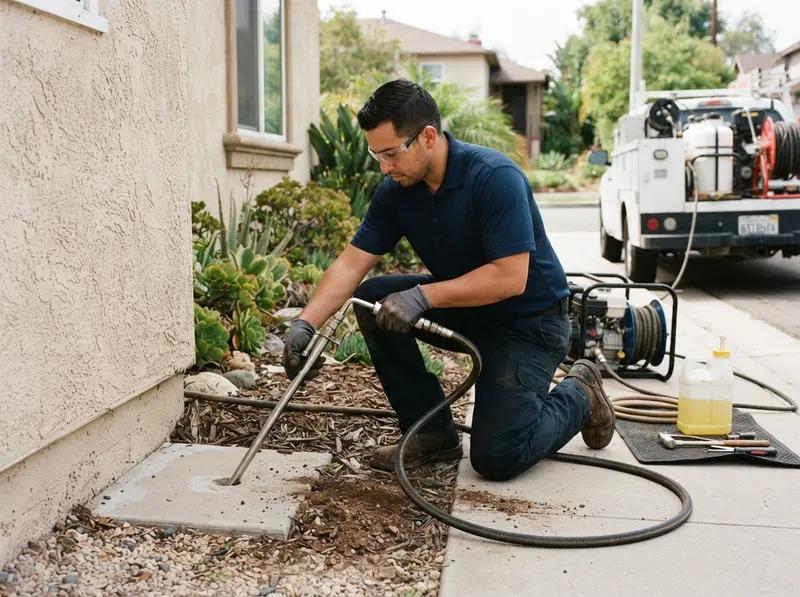
1. Technicians measure linear footage and inspect foundation stem walls for active shelter tubes and concrete fracture lines. 2. A continuous trench measuring six inches wide by six inches deep is excavated directly against the foundation wall. 3. Attached concrete patios, walkways, and driveway slabs receive vertical core drilling every twelve inches along the perimeter wall. 4. Calibrated rod injectors pump non-repellent termiticide into the soil matrix and slab sub-base at a target application rate of four gallons per ten linear feet per foot of depth. 5. Trenches are backfilled with treated soil, and core-drilled concrete ports are patched flush using non-shrinking hydraulic cement.

Pet and non-target safety protocols require keeping indoor pets away from exterior foundation zones during application until liquid treatments fully dry and bind to soil particles, typically two to three hours. The treatment does not require recurring monthly spray visits to retain efficacy; an uninterrupted barrier remains chemically active in undisturbed soil for five to eight years. Concrete drilling avoids post-tension cables and sub-slab radiant heating runs by referencing construction schematics, while homes adjacent to riparian zones near Elysian Park or Kenneth Hahn State Recreation Area observe strict environmental set-backs to prevent chemical runoff.

Subterranean Termite Soil Defense cost in Los Angeles

Baseline Inspection & Spot Trench Barrier (Minimum Charge)$250 - $450
Standard Slab Foundation Perimeter Treatment (150-200 Linear Ft)$1,200 - $1,850
Raised Foundation with Crawlspace & Exterior Perimeter (180-250 Linear Ft)$1,600 - $2,400
Hillside / Multi-Level Foundation with Concrete Slab Drilling (200+ Linear Ft)$2,200 - $3,500

Every job gets a firm, written price after a free on-site visit.

Common questions

How does subterranean termite soil defense differ from drywood termite tenting in Los Angeles?
Soil defense applies a liquid chemical barrier into the earth around foundation footings to intercept subterranean termites emerging from ground colonies, whereas fumigation tenting pumps gas through an enclosed structure to kill drywood termites living purely inside dry framing lumber.
Will liquid termiticide soil treatments in Los Angeles harm household pets?
Liquid termiticides bind directly to organic soil matter and concrete voids beneath ground level; once the treated trench is backfilled and dried over two to three hours, the chemical does not vaporize into the air or present contact risks to dogs and cats.
How often does a subterranean termite perimeter barrier need renewal in Los Angeles?
A continuous non-repellent perimeter treatment remains effective in Los Angeles County soils for five to eight years without recurring chemical reapplications, provided foundation soil remains undisturbed by excavation, landscaping changes, or seismic movement.
What is the minimum service cost for subterranean termite treatment in Los Angeles?
The minimum charge for any localized subterranean soil treatment or diagnostic barrier application is $250, with full-perimeter defense installations averaging between $1,200 and $3,500 based on property footprint and linear concrete drilling requirements.
Does subterranean soil defense require drilling concrete patios and driveways in Los Angeles?
Technicians must drill half-inch holes spaced twelve inches apart through concrete walkways, driveways, or patios abutting the foundation wall to inject termiticide beneath the slab, after which every hole is permanently sealed with hydraulic cement.
Helpful resources

Trusted references & local links

USA.gov, government & consumer helpBetter Business BureauFTC Consumer AdviceU.S. Small Business AdministrationReady.govU.S. EPAENERGY STARU.S. Dept. of EnergyConsumer.govU.S. Census BureauGoogle Maps, Los Angeles, CA

Get started today

Tell us about your subterranean termite soil defense job in Los Angeles and we'll send a clear, written quote, usually the same day.

Get your free Pest Control Service quote, Los Angeles

We only use your ZIP to check availability, no spam.